My Blog List

  • Love Quotes For Her - Perhaps you may call it ridiculous but cute quotes for your boyfriend can keep the love fires blazing hot. Cute quotes aren't only words and phrases, they...
    13 years ago
Showing posts with label Audi. Show all posts

Tuesday, 26 February 2013

Audi builds 5-millionth vehicle with Quattro


Quattro, the trademark name Audi has put on its all-wheel-drive system engineered for passenger vehicles, recently celebrated its five-millionth installation. The driveline has been offered in more than 140 different vehicles since its introduction more than three decades ago.

Audi 5000000

Audi 5000000

Audi 5000000

The all-wheel-drive technology made its world debut at the 1980 International Geneva Motor Show, beneath the floorpan of the Quattro Coupé, a low-volume two-door. It didn't take consumers long to embrace Audi's innovative approach. While most four-wheel-drive systems at that time utilized heavy transfer cases or second cardan shafts, Quattro was virtually tension-free, light, compact and efficient. Most importantly, enthusiasts found it was especially suitable for sports cars.

Today, the automaker offers Quattro on its full line of passenger vehicles and it is unquestionably successful (the technology enjoyed a 43 percent take rate in 2012). On models with transverse-mounted engines (A3 and TT), Audi uses an electronically controlled multi-plate clutch with hydraulic actuator. Under normal conditions, the clutch sends power almost exclusively to the front wheels (if wheel slippage occurs, up to 100 percent of the torque may be sent to the rear). Vehicles with engines mounted longitudinally (A4, A5, Q5, etc...) use a self-locking center differential sending 40 percent of the engine torque to the front axle and 60 percent to the rear under normal conditions (it is able to send the majority of the power to the axle with better traction when needed). The highest-performing Quattro systems use torque vectoring to further improve cornering grip and speeds.

Articles Source : Autoblog

Thursday, 21 February 2013

2013 Audi A3 e-tron Concept


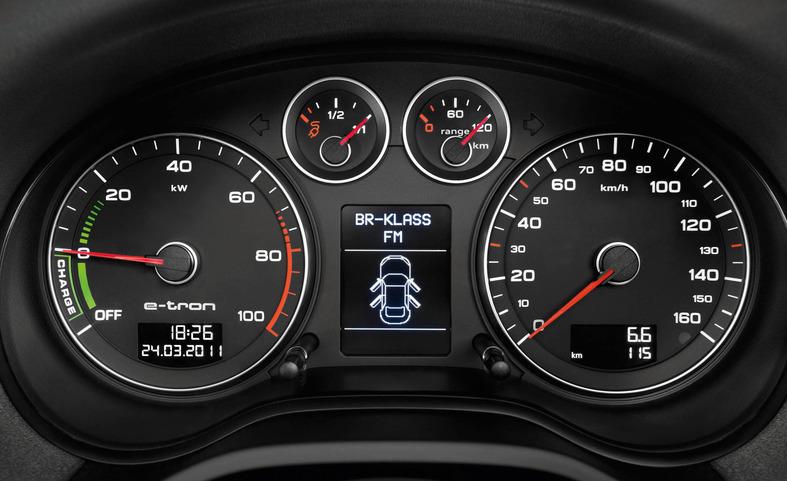
Audi is working intently to electrify the drivetrain using plug-in hybrid technology. The brand with the four rings is showing the Audi A3 e-tron at the 2013 Geneva Motor Show. With 150 kW (204 hp) of system power and 350 Nm (258.15 lb-ft) of system torque, sporty performance is guaranteed.

2013 Audi A3 e-tron Concept

2013 Audi A3 e-tron Concept

2013 Audi A3 e-tron Concept

2013 Audi A3 e-tron Concept

2013 Audi A3 e-tron Concept

The Audi A3 e-tron is a true Audi. It sprints from 0 to 100 km/h (62.14 mph) in 7.6 seconds on its way to a top speed of 222 km/h (137.94 mph). According to the ECE standard for plug-in hybrid automobiles, the five-door model consumes on average just 1.5 liters of fuel per 100 km (156.81 US mpg), which corresponds to CO2 emissions of 35 grams per km (56.33 g/mile). In electric mode, the Audi A3 e-tron reaches a top speed of 130 km/h (80.78 mph) and has a maximum range of 50 km (31.07 miles).

The combustion engine is a modified 1.4 TFSI producing 110 kW (150 hp). A clutch links the TFSI to an electric motor with an output of 75 kW. The disc-shaped electric motor is integrated into a newly designed six-speed e-S tronic, which transfers the power to the front wheels. The two powerplants complement one another. The electric motor delivers its peak torque from start to around 2000 rpm, and the TFSI's maximum pulling power is available in a range from 1,750 to 4,000 rpm.

The Audi A3 e-tron can be driven with just the combustion engine, just the electric drive or in hybrid mode. Even in electric mode it offers powerful acceleration without the need to engage the TFSI. The driver can choose to have both powerplants active at the same time ("boosting"). When the driver lets up on the accelerator, they both deactivate temporarily ("gliding"). In this way motor braking torque is eliminated and efficiency increases.

At the 2013 Geneva Motor Show, the Audi A3 e-tron will provide a realistic glimpse into the future of mobility as Audi is planning it. The electrification of the drivetrain, above all using plug-in technology, plays a deciding role in the strategy of the brand.

Articles Source : Netcarshow

New Audi RS Q3 Proves that it’s Faster than a Dog Sled in Promo Video

If there's one thing future owners of the new Audi RS Q3 can be sure of, it is that the high-performance SUV can outrun and out-handle a pack of Siberian huskies pulling a dog sled on the snow - or at least that's what we understand after seeing Ingolstadt's first commercial for the Geneva motor show-bound model.
What makes the RS Q3 faster than a pack of blue-eyed pouches is a petrol-fuelled 2.5-litre turbocharged five-cylinder engine that generates an output of 306hp (310PS) and peak torque of 420Nm (309.8 lb-ft).

Audi RS Q3

A standard seven-speed S tronic dual clutch transmission and a quattro permanent all-wheel drive system take that power and channel it to all four wheels.

If you live in Europe, you'll be able to get your hands on Audi's first ever RS-badged SUV this autumn.

Articles Source : Carscoop

 Video Source : Youtube

Wednesday, 20 February 2013

2014 Audi RS Q3


Audi is presenting the RS Q3 at the 2013 Geneva International Motor Show, the first RS model for the successful Q line-up. It combines outstanding everyday practicality with dynamic driving performance: It takes just 5.5 seconds to complete the sprint from 0 to 100 km/h (62.14 mph), and its top speed is electronically governed to 250 km/h (155.34 mph). The 2.5-liter five-cylinder turbo produces 228 kW (310 hp) and has an average fuel consumption of just 8.8 liters of fuel per 100 km (26.73 US mpg).

2014 Audi RS Q3
2014 Audi RS Q3

2014 Audi RS Q3
2014 Audi RS Q3

2014 Audi RS Q3
2014 Audi RS Q3

2014 Audi RS Q3
2014 Audi RS Q3

2014 Audi RS Q3
2014 Audi RS Q3

2014 Audi RS Q3
2014 Audi RS Q3

2014 Audi RS Q3
2014 Audi RS Q3

2014 Audi RS Q3
2014 Audi RS Q3

2014 Audi RS Q3 Interior
2014 Audi RS Q3

2014 Audi RS Q3 Interior
2014 Audi RS Q3

"The RS Q3 transfers the performance philosophy of Audi to the compact SUV segment, thereby creating a new performance class," says Franciscus van Meel, Managing Director of quattro GmbH. "In addition to the RS5 Cabriolet, RS6 Avant and RS7 Sportback, the RS Q3 is the fourth RS model that we are launching on the market in 2013. The RS family is growing to eight members - more than ever." The RS Q3 combines typical RS properties such as high performance and driving pleasure with lifestyle qualities and high utility value. The Audi RS Q3 was developed by quattro GmbH which is a wholly-owned subsidiary of AUDI AG.

An award-winning high-performance engine, the 2.5 TFSI, is at work under the hood of the Audi RS Q3. This five-cylinder engine has been named "International Engine of the Year" in its class for three consecutive years since 2010 by an international jury of automotive specialists. From 2,480 cc of engine displacement, the turbocharged direct-injection engine produces a maximum power of 228 kW (310 hp) at 5,200-6,700 rpm; its maximum torque of 420 Nm (309.78 lb-ft) is available between 1,500 and 5,200 rpm. These two values signify that the RS Q3 is unrivaled in its competitive field. This five-cylinder is a special engine, beginning with its fundamental concept. It is familiar from the TT RS and RS3 Sportback, and quattro GmbH modified it for use in the RS Q3.

The 1-2-4-5-3 ignition sequence, supported by the geometry of the air induction and exhaust systems, generates a sporty engine sound that first made Audi popular back in the 1980s.

Drivers can influence the flap control for the exhaust system and the accelerator characteristic by choosing one of the modes auto, comfort and dynamic using the standard Audi drive select system. In the dynamic mode, engine response is sharper and the engine sound more intensive.

The 2.5 TFSI accelerates the Audi RS Q3 from a standstill to 100 km/h (62.14 mph) in just 5.5 seconds - the best performance value in this segment. The vehicle's top speed is electronically limited to 250 km/h (155.34 mph). In the RS Q3, the Audi five-cylinder engine is working together with a standard start-stop-system for the first time. Other efficiency measures such as a regulated oil pump, which only pumps lubricant when needed, contribute to the car's low average fuel consumption of 8.8 liters of fuel per 100 km (26.73 US mpg) which equates to 206 grams CO2 per km (331.52 g/mile).

A standard seven-speed S tronic transfers power to the drivetrain. It was designed in a compact three-shaft configuration, and its seventh gear has a long gear ratio to save on fuel. Drivers can choose between the D and S modes for automatic shifting of the dual clutch transmission, or they can shift manually - using the shift paddles on the steering wheel or the selector lever that sports a unique RS design. The Launch Control function controls acceleration from a standstill to attain optimal traction.

The heart of the quattro permanent all-wheel drive system is the hydraulically operated and electronically controlled multi-plate clutch located at the rear axle. It ensures proper distribution of torque between the front and rear axles.

The Audi RS Q3 impresses with dynamic and stable handling without sacrificing comfort. The RS sports suspension lowers the body of the compact high-performance SUV by 25 mm (0.98 in). The battery is located in the luggage compartment to achieve better weight distribution. The independent rear wheel suspensions are controlled by four links.

The electro-mechanical rack and pinion steering system operates very efficiently, conveying a stiff, precise steering feeling. An electro-mechanical parking brake and hill hold assist are also standard.

In the Audi RS Q3, the internally ventilated and perforated brake discs at the front wheels have a wave design with wave-shaped outer contours, which saves approx. one kilogram (2.20 lb) of weight at the front wheels. The discs have a diameter of 365 mm (14.37 in), and they are gripped by eight-piston calipers painted black with RS logos. The electronic stabilization control (ESC) has a sport mode, and it can also be deactivated entirely.

The Audi RS Q3 comes on the German market with standard 19-inch alloy wheels. Three versions of 20-inch wheels are offered as well. One of these is the exclusive 5 dual-spoke V design, which is based on the Audi RS Q3 concept car that was shown at the 2012 Auto China motor show.

In addition to its engine, the Audi RS Q3 also demonstrates its special status within the Q3 line-up with a number of visual highlights. RS-specific design details emphasize the confident look of the compact, high-performance SUV. They consist of body accents and roof rails in matt aluminum, special door sill plates and door trim strips, a high-gloss black honeycomb front grille, RS front bumper and quattro emblem in the front air intake. A large roof spoiler, rear bumper with distinctive diffuser insert, large elliptical tailpipe and an RS Q3 logo accentuate the rear. At a length of 4,410 mm (14.47 ft), the dynamic top model is 25 mm (0.98 in) longer than the Audi Q3. It weighs in at 1,730 kg (3814.00 lb).

The Audi RS Q3 can also be customized by one of two optional styling packages - matt aluminum or black. Styling features include the flaps in the side air intakes, the trim on the diffuser and the fins on the roof spoiler. The Audi RS Q3 is available in eight exterior colors, including the exclusive Sepang Blue pearl effect.

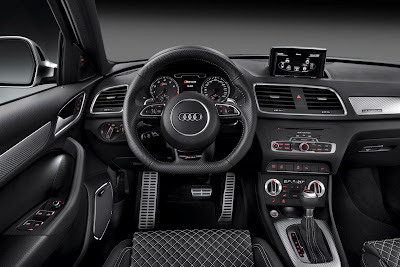
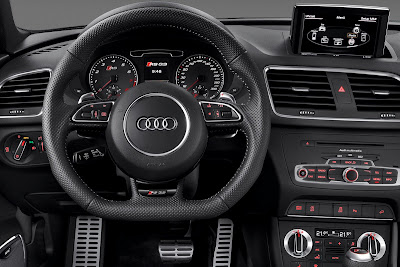
The sporty lines of the exterior are continued in the interior styling. The instrument cluster has gray gauges with white scales and red pointers. Contrasting stitching in rock gray trim the three-spoke multifunction steering wheel with its flat bottom as well as the gear selector lever. The MMI and driver information system displays welcome the driver with the RS logo. Drivers can call up the boost pressure, oil temperature and a lap timer via the RS menu in the driver information system.

Along with the pedals, a foot support also shines in aluminum look, and the standard inlays are in piano finish black. quattro GmbH offers aluminum race or carbon as alternatives here. Black headlining is standard, and lunar silver headlining is optional.

Sport seats with embossed RS Q3 logos are also standard and are upholstered in black Alcantara/leather. Customers can also choose the optional Fine Nappa leather in black or lunar silver with contrasting stitching in rock gray or the design package with diamond stitching.

The cargo area has a base capacity of 356 liters (12.57 cubic ft), which can be increased to 1,261 liters (44.53 cubic ft) by folding down the split rear seat backs. A practical reversible loadliner is standard. Those wishing to transport even more cargo can order the towing bracket that is offered for the RS Q3.

Other standard features of the Audi RS Q3 include - in addition to the RS-specific driver information system - park assist plus, Audi sound system with ten loudspeakers, xenon plus headlights and LED tail lights. When they are not lit, the tail lights display a dark red tint.

In the infotainment area, a modular component system offers a wide range of options; at the top there is the hard-drive based navigation system, MMI Navigation plus. The surround sound system from Bose drives 14 loudspeakers with up to 465 watts of output power, while the Bluetooth car phone online together with WLAN hotspot connects the compact high-performance SUV with the Internet and brings the online services of Audi connect into the vehicle. Highly advanced driver assistance systems round out the options program.

In Germany, the base price is €54,600, and deliveries begin in fall 2013.

Articles Source : Netcarshow

New Audi RS Q3 with 306HP 2.5-liter Turbocharged Inline-Five is Official


Only hours after we posted the first pictures of the Audi's hot compact SUV, the brand with the four-ring logo came out with a plethora of official images and details on the new RS Q3, which will be displayed at the 2013 Geneva International Motor Show in early March.

Audi RS Q3

Audi RS Q3

Audi RS Q3

The transformation from the concept model we saw at last year's Beijing auto show to a production car brought only a few minor cosmetic changes, such as the replacement of the carbon fiber trims inside and out with aluminum or black-colored parts, and a de-tuning of the TT RS- and RS3-sourced 2.5-liter turbocharged unit, dropping power from 350hp (355PS) to 306hp (310PS).

The inline-five, which produces a peak torque figure of 420Nm (309.8 lb-ft) available between 1,500 and 5,200 rpm, is connected to a standard seven-speed S tronic dual clutch transmission that transfers power to all four corners via Audi's quattro permanent all-wheel drive system with a hydraulically operated and electronically controlled multi-plate clutch located at the rear axle.

So how fast is the production RS Q3? According to Ingolstadt, it takes 5.5 seconds to complete the sprint from 0 to 100 km/h (62mph), and its top speed is electronically governed to 250 km/h (155mph). As far as fuel economy is concerned, the performance version of the Q3 series returns a combined figure of 8.8lt/100 km (26.73 US mpg or 32.1 UK mpg).

To improve handling, quattro engineers tweaked the suspension and lowered the ride height by 25mm (about an 1 inch), placed the battery in the luggage compartment (for better weight distribution), and added ventilated and perforated brake discs up front and larger discs at the back gripped by eight-piston calipers.

Furthermore, the electronic stabilization control (ESC) has a sport mode, and it can also be deactivated entirely, while there's a Launch Control function as well. Audi says the RS Q3 weighs in at 1,730 kg (3814.00 lb).

On the outside, Audi made sure to separate the RS model from the plebeian Q3s through a number of visual highlights, such as the exclusive 19-inch or optionally, 20-inch wheels, body accents and roof rails in matt aluminum, high-gloss black honeycomb front grille, RS front bumper, a rear diffuser with a single oval tailpipe and a roof spoiler.

The interior is upgraded with bespoke sport seats upholstered in black Alcantara and leather, with diamond stitching offered as an option, a revised instrument cluster with gray gauges and white scales and red pointers, a flat –bottom steering wheel, and plenty of aluminum trims and parts.

First deliveries in Europe will start this fall, with pricing in Germany to start from €54,600 or about US$73,100.

Articles Source : Carscoop

Audi's New RS Q3 Super SUV Makes an Early Online Debut in Production Trim


Images of the production version of the Audi RS Q3 have been leaked online ahead of the high-performance crossover's official premiere, which will likely take place in Geneva next month.
We will remind you that the RS Q3 was previewed through a thinly disguised concept model at the 2012 Beijing Auto Show.

Audi RS Q3

Audi RS Q3

Audi RS Q3

Audi RS Q3 Interior

Audi RS Q3 Interior

These first pictures suggest that Audi has made only minor changes to the concept, mainly by replacing the carbon fiber accents and trims, both inside and out, with aluminum finish parts. In addition, the aluminum-style backgrounds of the instrument panel gauges have given their place to a more traditional black layout.

We suspect that the powertrain will be the same as in the concept, which featured the TT RS’ 2.5-liter turbocharged inline-five rated at 355-horses allowing the subcompact crossover to complete the 0-100 km/h (0-62 mph) sprint in 5.2 seconds and top out at 265 km/h (165 mph), but we'll have to wait for the official release to be sure.

Articles Source : Carscoop

Thursday, 14 February 2013

New Generation Audi A3 Sportback Modded by ABT Sportsline


ABT Sportsline releasing a package of goods for a new Audi model is just about as sure as the sun coming out again tomorrow. Having already taken care of the three-door version of Audi's MQB-platform based A3, the German tuner has now presented an assortment of upgrades for the five-door A3 Sportback.
The world’s largest full-line tuner of Volkswagen group cars starts with the Sportback's exterior and a styling kit comprising a new front grille and lip spoiler, with matching fender inserts, side skirts, a roof spoiler and a rear apron that makes space for the new quad tailpipe exhaust system.
2013 ABT Audi A3 Sportsback

2013 ABT Audi A3 Sportsback

2013 ABT Audi A3 Sportsback

2013 ABT Audi A3 Sportsback

2013 ABT Audi A3 Sportsback

2013 ABT Audi A3 Sportsback

ABT's choice of wheels is the DR series available in 18- and 19-inches in diameter, while you can enhance the car's stance and improve handling with a sports suspension that lowers the ride height by 35mm (1.4 inches).

Under the hood, ABT has made considerable advancements in output levels. In particular, 1.4-liter TSI petrol is boosted from 122PS (120hp) to 160PS (158hp) and the 2.0-liter diesel from 150PS (148hp) to 180PS (178hp). Later on, ABT will offer a kit for the 1.6-liter TDI and the 1.8-liter TSI.

A new ABT brake system with larger discs (345 mm in diameter) and matching steel-flex brake lines complete the brand's current offerings for the new A3 Sportback.

Articles Source : Carscoop

Monday, 11 February 2013

Prior Design's Audi R8 GT650 Hits the Snow for a New Photo Shoot


Are you still not convinced about Prior Design's GT650 cosmetic package for the Audi R8 sports coupe? Well, while nothing has changed since the German tuning house first told us about its R8 offerings in December, Prior Design sent over a fresh batch of pictures of the GT650 posing outside on the snow.

Audi R8 sports coupe

Audi R8 sports coupe

Audi R8 sports coupe

Audi R8 sports coupe

Audi R8 sports coupe

Audi R8 sports coupe

Audi R8 sports coupe

Audi R8 sports coupe

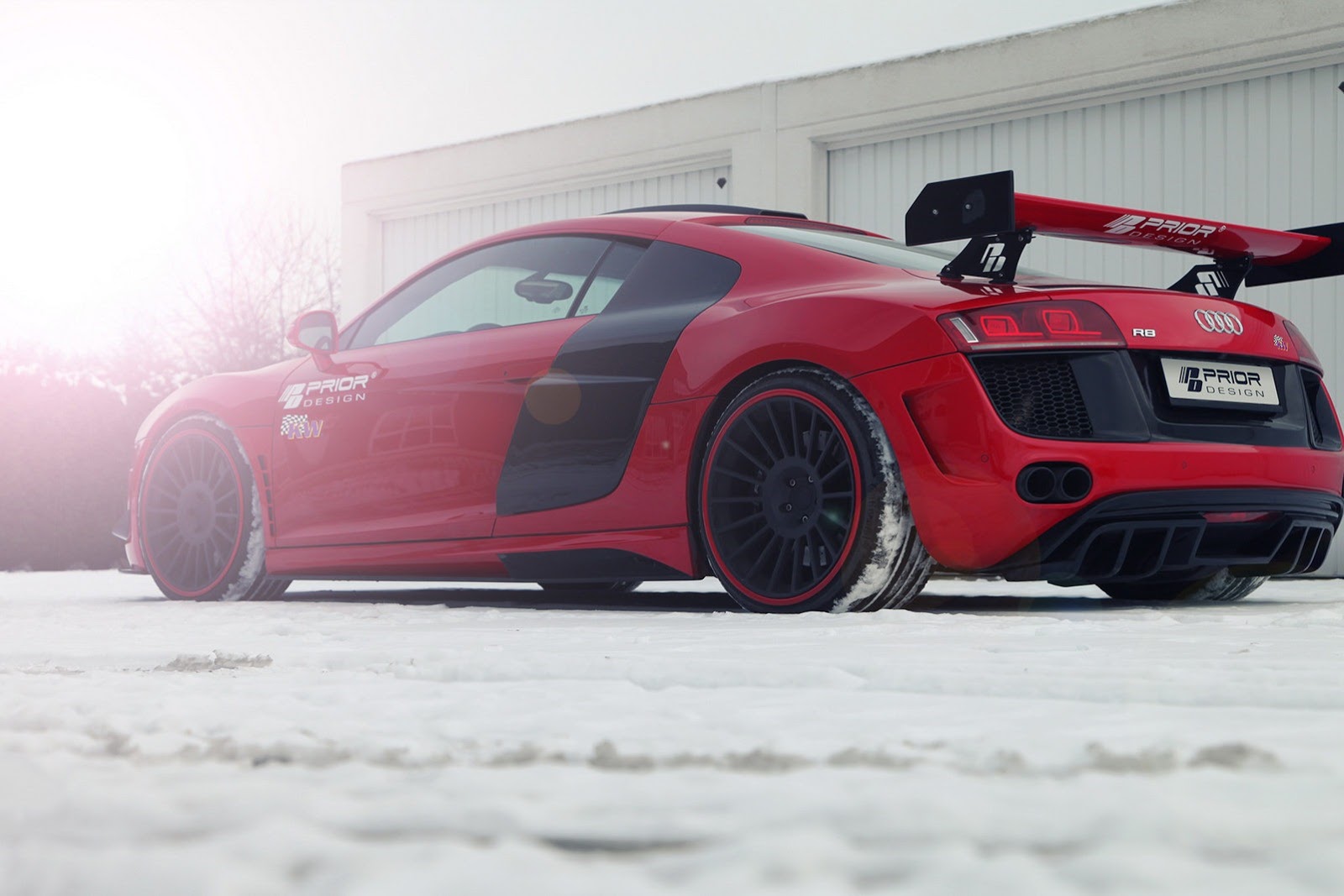
As a reminder, the pricey body kit will cost you €19,900, which comes to around US$26,700 at today's currency rates, and for which you get a new front bumper with canards and a lip spoiler, wider front fenders, a revised rear bumper and diffuser combo, a roof scoop, side skirts and a fixed rear wing.

To complete the look, you will need to get the black alloy wheels with a red accent ring that are priced at €9,000 or US$12,000 for the complete set with the tires.

Articles Source : Carscoop

Sunday, 27 January 2013

2014 Audi RS7 Sportback officially unveiled


Audi unveiled the new RS7 Sportback at the 2013 North American International Auto Show. The German sports car is powered by a turbocharged 4.0-liter engine capable to produce 552 horsepower and 516 lb-ft of torque.

2014 Audi RS7 Sportback

2014 Audi RS7 Sportback

2014 Audi RS7 Sportback

2014 Audi RS7 Sportback

Thanks to an eight-speed tiptronic transmission, the 0-100 km/h acceleration is possible in 3,9 seconds while the top speed is limited at 250 km/h.

You can get rid of the speed limiter at extra price, situation where the top speed increases to 305 km/h.

Thanks to a new cylinder deactivation system, the new Audi RS7 Sportback returns a decent fuel consumption of 24mpg US or 9,8 liters/100km.

A high-performance brake system with 420mm carbon fiber ceramic discs keeps the model safe while a retuned air suspension with adaptive damping lowers the ground clearance by 20mm.

While the exterior receives new front and rear bumpers, a revised front grille, large 20-inch alloy wheels and carbon fiber parts, interior features include new sport seats, a flat-bottom steering wheel and new door sills.

Articles Source : automotorblog

Tuesday, 15 January 2013

2014 Audi RS7 Sportback


The Audi RS7 Sportback, which made its debut at the 2013 North American International Auto Show in Detroit, stands for dynamics at their most beautiful. The large five-door coupe uses a 4.0 TFSI engine producing 412 kW (560 hp). The sprint from zero to 100 km/h (62.14 mph) takes just 3.9 seconds, and the speed governor can be deactivated upon customer request to permit a top speed of up to 305 km/h (189.52 mph). Despite this superior performance, the Audi RS7 Sportback consumes on average just 9.8 liters of fuel per 100 km (24.00 US mpg).

2014 Audi RS7 Sportback

2014 Audi RS7 Sportback

2014 Audi RS7 Sportback

2014 Audi RS7 Sportback

2014 Audi RS7 Sportback

2014 Audi RS7 Sportback


2014 Audi RS7 Sportback

2014 Audi RS7 Sportback

2014 Audi RS7 Sportback

2014 Audi RS7 Sportback

Aesthetic design, innovative technology and impressive sportiness: The Audi RS7 Sportback, the large five-door coupe from Audi, combines many strengths to produce a fascinating character. Its strong heart is the 4.0 TFSI, which takes Audi's downsizing strategy to the high-end category. The twin-turbo V8 displaces 3,993 cc and develops awesome power, with 412 kW (560 hp) available between 5,700 and 6,700 rpm. A constant 700 Nm (516.29 lb-ft) of torque are available between 1,750 and 5,500 rpm.

Because the high-revving four-liter engine has been rigorously designed for low load-change and flow losses, it develops this power quickly and spontaneously. The cylinder heads have the exhaust side on the inside and the intake side on the outside. The two twin-scroll turbochargers, which produce up to 1.2 bars of relative boost pressure, are located together with the intercooler in the inside V of the cylinder banks. Consequently, the gas paths are very short and response very good. The RS-specific engine management and unthrottled intake system also contribute to the dynamic character of the twin-turbo V8. Switchable flaps in the exhaust system make the engine sound even fuller at the push of a button or under strong acceleration. Audi also offers an optional sport exhaust system.

The Audi RS7 Sportback sprints from 0 to 100 km/h (62.14 mph) in just 3.9 seconds. Audi limits the top speed in the standard configuration to 250 km/h (155.34 mph). Top speed with the optional dynamic package is 280 km/h (173.98 mph) and 305 km/h (189.52 mph) with the dynamic package plus.

Yet the new top model of the model series consumes on average just 9.8 liters of fuel per 100 km (24.00 US mpg). This top value is due in part to the standard start-stop system and innovative thermal management.

The most innovative efficiency technology in the new Audi RS7 Sportback is the cylinder on demand (COD) system. At low to medium loads and engine speeds, it deactivates cylinders 2, 3, 5 and 8 by closing their valves via electromechanical actuators. The 4.0 TFSI then runs as a four-cylinder engine until the driver accelerates more strongly again. The operating points in the active cylinders are displaced toward higher loads, increasing efficiency.

All of these operations take just a few hundredths of a second and occur so smoothly and quickly that they can hardly be felt or heard. Active engine bearings, another high-end solution from Audi, use out-of-phase counter-oscillations to compensate for the slight vibrations that occur during four-cylinder operation. The COD technology reduces NEDC fuel consumption by roughly five percent, and even greater savings of approximately 10 percent are possible when driving at moderate speeds.

The standard eight-speed tiptronic is specially tuned to the sporty character of the Audi RS7 Sportback. Drivers can choose between the modes D and S or change gears themselves using the shift paddles on the steering wheel or the selector lever, which sports a unique RS design. While the lower gears of the tiptronic are closely spaced for sporty response, eighth gear is tall like an overdrive to reduce fuel consumption.

The Audi RS7 Sportback comes standard with quattro permanent all-wheel drive for its decisive advantage in traction and driving safety compared with its two-wheel-drive competitors. At the heart of the quattro system is a center differential with a high locking rate and a separate oil cooler to regulate its temperature. It distributes the power as needed within a wide range between the front and rear axles. In the standard configuration, 60 percent flows to the rear and 40 percent to the front.

An intelligent software solution called torque vectoring supports the work of the differential at the cornering limit with minimal braking of the wheels that are under a reduced load. Audi also offers the optional sport differential for the rear axle, which uses two superposition gears to actively distribute the power between the wheels.

The Audi RS7 Sportback comes standard with polished, 20-inch forged lightweight wheels in a seven twin-spoke design. The five-door high-performance coupe also rolls on optional 21-inch cast wheels in a choice of three designs.

Powerful brakes are located behind the large wheels. The four internally vented discs feature a weight-saving wave design and measure 390 millimeters (15.35 in) in diameter up front. Pins decouple the steel friction rings from the aluminum brake caps. Black painted six-piston calipers - optionally available in red - grip the discs. Audi also offers optional 420 millimeter (16.54 in) carbon fiber ceramic discs with anthracite gray calipers. The electronic stabilization control (ESC) has a Sport mode and can also be deactivated entirely.

Equipped with the air suspension, which harmonizes perfectly with the dynamic character of a sport coupe, the new Audi RS7 Sportback is sporty, yet still comfortable. The Audi RS7 adaptive air suspension lowers the body by 20 millimeters (0.79 in). Adaptive damping, another of the system's features, adjusts the suspension's response to the condition of the road, the driver's style and the mode selected in the Audi drive select system, with which the driver can alter the function of key components in multiple steps.

Audi offers the taut sport suspension plus with dynamic ride control (DRC) as an alternative to the air suspension. It uses steel springs and three-stage adjustable dampers that are connected to one another via diagonal oil lines and a central valve. Another option, which can also be integrated into Audi drive select, is the dynamic steering with its steplessly variable steering boost and ratio. As with the standard electromechanical steering, its characteristics are specially tailored for the Audi RS7 Sportback.

The body of the Audi RS7 Sportback includes up to 20 percent aluminum and includes many parts of high-strength and ultra high-strength steels. Its high rigidity is the foundation for the precise handling, excellent workmanship and quiet cabin free of intrusive noise.

The character of the Audi RS7 Sportback is immediately obvious. A series of specific design details give a sporty edge to its flowing coupe design. These include the distinctive bumpers and high-gloss black protective grille with honeycomb structure at the front of the car as well as add-on parts in matt aluminum. At the rear of the car, which features a power extending spoiler, the diffuser and the two large, elliptical tailpipe trims of the exhaust system catch the eye.

The Audi RS7 Sportback is available in a choice of ten exterior colors, including the new shade Nardo gray and the exclusive finish Daytona gray, matt effect. Two styling packages - matt aluminum and carbon - further customize the appearance. With these, the front center air inlet also sports a quattro badge. With the carbon styling package, the front splitter and the diffuser are somewhat more boldly shaped. Other options include the exterior mirrors with exposed carbon housings and the all-LED headlights, whose designer trims are tinted for a unique look.

The elegant dynamics carry over to the cockpit of the Audi RS7 Sportback. The dial instruments have black faces, white scales and red needles. A 3D RS7 logo in the tachometer is a further accent. The key, the flat-bottomed, three-spoke leather steering wheel, the illuminated door entry sills and the displays for the MMI and driver information system also sport RS badges. The driver information system includes a shift light, which indicates when the rev limit is reached. Displays for boost pressure and oil temperature plus a lap timer round out the RS7-specific menu.

Colors and materials provide for further differentiation. The footrest, pedals and soft keys in the standard MMI navigation plus terminal shine in an aluminum-look finish. The decorative trim below the retractable monitor sports a piano finish.

Carbon inlays are standard, with four additional materials available as options. The headlining comes standard in black cloth, with options for lunar silver or black Alcantara. Of course, the Audi RS7 Sportback can also be personalized using the Audi exclusive program.

RS sport seats with pronounced side bolsters, integrated head restraints and RS7 logos are standard. They are covered in a combination of black Alcantara and leather, and the center sections feature diamond quilting. The seats can also be covered alternatively in high-grade, honeycomb-quilted Valcona leather in either black or lunar silver. Audi offers optional power-adjustable comfort seats with memory function. The two rear seats are powerfully contoured. Luggage capacity ranges from 535 to 1,390 liters (18.89 to 49.09 cu ft) depending on the position of the rear seat backs.

The Audi RS7 Sportback comes with a generous list of standard equipment, including xenon plus headlights, a tire pressure monitoring system, the parking system plus, three-zone automatic air conditioning, cruise control and the Audi sound system in addition to features mentioned previously. High-end options include a head-up display, a comfort package, the dynamic package and the dynamic package plus.

The Bluetooth online car phone is an ideal complement to the standard MMI navigation plus. Its UMTS module delivers the tailored Audi connect services to the on-board monitor, and a WLAN hotspot connects the passengers' mobile devices. Topping the range of audio modules is the Advanced Sound System from Bang & Olufsen.

The Audi RS7 Sportback also leads the pack when it comes to driver assistance systems. One of these is the adaptive cruise control with stop & go function including Audi pre sense front. This keeps the powerful coupe at the proper distance from the car ahead and in many situations can help to avoid accidents or mitigate their consequences.

Audi active lane assist helps the driver to keep the Audi RS7 Sportback on course. The park assist handles the steering when parking. The night vision assistant with highlighting of detected persons reduces the stress of driving in the dark. Audi side assist and the speed limit display round out the list.

Articles Source : Netcarshow